

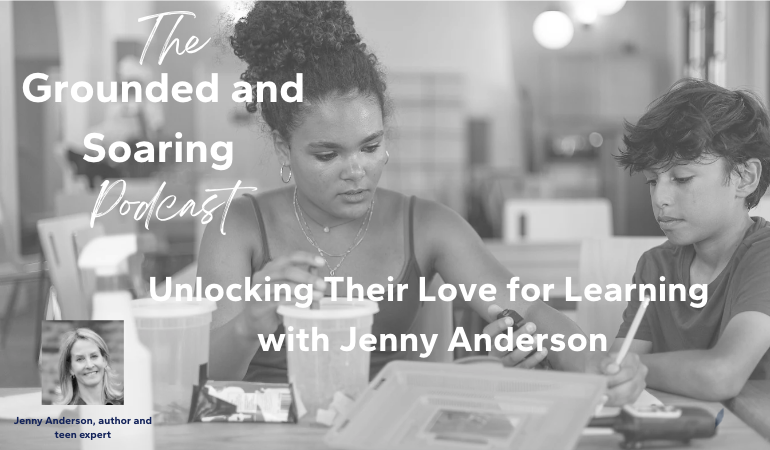
While 74% of third graders report loving school, only 26% of tenth graders say the same—a reality missed by the 65% of parents who assume their teens are thriving. Journalist and The Disengaged Teen co-author Jenny Anderson joins Head of School Sam Shapiro to unpack the four modes of adolescent engagement and share concrete ways parents can lower grade pressure, stop nagging over homework, and help teenagers take ownership of their learning.
Episode Transcript
What Alumni Can Teach Us
00:00 · Neyla
Okay, are you ready? Welcome back to Grounded and Soaring, the podcast for parents trying to raise healthy kids in a too often unhealthy world. I’m Terry Dubow, Director of Communications at Marin Montessori School. And I think you’re going to like today’s episode. I know I’m going to because I get a chance to connect with some recent alums of MMS who are making their mark on various high schools around the Bay Area. We’re going to check in, see how high school’s going, hear their perspectives on technology, education, and the extent to which their MMS years prepared them for life beyond our campus.
00:33 · Terry Dubow
So we have Neyla, who’s a junior at the Branson School. Hey, Neyla. Hi. That’s what Neyla sounds like. We’ve got Asher, who’s a sophomore at Marin Academy. Hello, Asher. Junior at Marin Academy. Hey, Terry. Did you say you’re Marin Academy, are you? Yeah, junior. Already. Yeah, moving so quick. Oh, God, I had that wrong. Oh, then we got Solomon. He’s a freshman or first year? What do you say? Freshman, freshman at Bay. Bay. Freshman at Bay School down there in the Presidio? In the Presidio, yep.
01:10 · Terry Dubow
The views there, man, incredible. All right, so we got heavy hitters here from MMS. These are great people. So we’re just gonna get in, but before we get started, can you just go around quickly and tell us how long you spent at MMS and maybe one experience from MMS that kind of sticks with you the most? Neyla, do you want to start? How long were you there and what sticks with you? Sure. I was at MMS for eight years from first grade through eighth, all the way through the junior high. And something that really stuck with me or like an experience, is that what you’re talking about? An experience or I don’t know, something that you remember most ’cause you’ve been out for a little bit. – Yeah, something that I think I remember most, probably at the junior high since that was most recent was.
02:03 · Neyla
A lot of fun group projects and a lot of Fun group projects. A lot of collaboration throughout the school. I think that MMS really focused on collaboration a lot and I remember a lot of fun group projects or school-wide projects, like all of the math classes coming together to create circus games using probability. That was a really fun memory, I think. That I think about a lot. Cool. All right, Asher. How long were you there and what do you remember most? Yeah, I started in second grade and was there until my ninth grade full cycle year at the junior high. Something I remember most and miss a little bit about. I miss sometimes is the hands on learning through almost everything and like how it really fostered my curiosity for things. I like often think when I’m in math class about how I like developed my love for math through. Like flat bead frames, um, and just like flat bead frames. And just like the ability to kind of like Neyla said. Just be able to have that hands on learning. But also like the collaboration. Yeah, it really helped me enjoy learning so much. Cool. What are you, Solomon? Yeah, so I joined MMS in fifth grade in 2021 and finished my full soccer year in ninth grade in 2026. And I think something that’s definitely or at least a good memory that stuck with me is.
03:31 · Solomon
When I worked kind of the entire junior high on building a tiny house that will go to unhoused youth in our carpentry program. And I think that was really special for me because I knew that was going to be a real world impact. And then finally. This summer hearing that it was donated and that it did go to a good cause and that really resonated with me. Cool. Yeah. No, it was a cool moment when that finally left campus. Yeah pretty awesome project. Yeah, a lot more involved in it for years, right? Like five years. Yeah, yeah, it’s nice to play a small role, but it’s cool. It’s all matters, right? Okay.
04:08 · Terry Dubow
So first question. What stood out to you the most as a glaring difference between MMS and your high school? Like, if you had to pick one thing that was like, oh. This feels different. What was it? I think probably the biggest difference and something I noticed pretty quickly was the Homework load felt different and I definitely had more homework in high school than I did in the junior high. And I mean there was an initial um like couple weeks of adjusting to this new routine and this new workload but what I like really noticed was. That although I was faced with these new challenges and new homework load. The time management skills that we gained and we practice a regular Time management skills that we gained and we practiced so regularly at the junior high was something that was, I mean, really, really helpful. And I mean. For example some of the things that we practiced were we use planners to plan our schedules and our afternoons. We meet and check in with our teachers and advisors. And I think one of the most important things was the personal audit projects, which are these really cool trimester long passion projects. But I mean.
05:25 · Asher
All these things have helped me take these big big projects that I now have and help me break them up into these smaller steps, which has helped me with things in high school that go span from, I mean. My a lot heavier workload to extracurricular projects that I think more homework wouldn’t have done more homework in middle school wouldn’t have done the same amount of. Help for me. That’s interesting. It was like more homework earlier wouldn’t have helped you. You’re saying. It’s like it was actually the learning how to plan your time. Yeah. Exactly. Really like practicing those and developing those skills of time management. Anybody else want to jump in on this one? I got more. I was just going to say that a big thing for me was advocacy for like any sort of help or being able to talk to teachers. I think.
06:23 · Neyla
That MMS really focused on that teacher student relationship. And I noticed when I Went to Branson School. When I had my first day of Branson School, even that students were scared to ask their teachers for help or to even talk to them about anything or just advocate for themselves in general. And before I came to MMS. A big problem for me was advocating for myself. And I think that the junior high, especially really focuses on fostering that relationship and showing that teachers want to help you and that they’re willing to help you and they’re very open about it. Yeah. Yeah, good. So, do you want to jump in or you got another? Yeah. No, I think the first thing, obviously.
07:03 · Solomon
That stood out to me was that I think my graduating class was something like 18 kids. And, you know. I hit the grade, and it’s like 110 kids in ninth grade, and our whole school is maybe 500. And I think, like, for me. I’ve never been used to that. I’ve always gone to very small schools. And I think that definitely something that MMS helped me develop was like the face-to-face just human talking to human and not being on a screen and making those social interactions with the people around you really helped me to kind of find my people very early on into the year. And that also helped me interact with my teachers as well and develop a relationship where I’ve seen other kids where they’re not unsure or think it’s wrong to go to their teacher. And ask for help. But I really think that’s very important and MMS definitely helped me build those skills that way when I got to high school I already felt confident I already felt kind of like I knew what to do if I Had issues. And I think that’s definitely the big difference is class size as well. – that’s great. Actually.
08:03 · Terry Dubow
So good. Let’s double click on technology ’cause that’s one of the big questions. You know, the junior high sort of you don’t have much access to technology. It’s not a tech heavy school. There’s laptops and things like that for writing and research. But it’s pretty low tech. What did you notice in high school about technology? How have you adapted to it? Do you think there were benefits from spending those early teen years in a low tech environment. Or do you think you missed out? What’s your general take on all that? I’ll hop in on this one. I think absolutely not having.
08:35 · Neyla
That much access to tech has helped me so much. And I’ll say why. I think first through sixth grade, it was pretty much no screens. So you were, if you had a study that you were working on you were finding books or you were going to the library and checking out books and doing research by hand and writing down everything, writing in cursive. Especially. And Once I got to the junior high, we started using things like Chromebooks. But it was very limited usually only for writing our essays or if we had to look up sources for whatever project we were doing. And I think that really helped because once I got to high school. So many kids were asking teachers whether they could do things using tech. And teachers were really trying to refrain from that to sort of keep the basic need of writing and keeping physical notes. And I think students really struggled with that because they were relying on you know, typing and especially AI tools. Whereas MMS, it was pretty much hands on there was no technology use. And I just didn’t see a need for it. I didn’t rely on it. And I think the biggest thing for me was just not having to rely on something else for my learning. And one memory I have was a student asking in freshman year, I think, whether we could use Grammarly to help with our essays. And I was like. I’ve never even used it. To help with our essays. And I was like.
09:59 · Neyla
I’ve never even used Grammarly before. I don’t know what that is. And I didn’t feel like I was tied to something. And I think that MMS did a great job of that. Where in the really techie world. We still need to have that sort of human thought. And MMS has really done a great job of preserving that. Great. What do you guys think? I like that double click on technology. I’m clever that way, aren’t I? Yeah. I definitely noticed, like, as Neyla said, I definitely noticed technology a lot more in my daily life. I mean.
10:36 · Asher
In many of my classes. I use it for research, writing, other activities. But I completely agree with what Neyla said. I think the intentionality that we use and the way we use technology in the junior high has really helped me create a relationship. With technology now, where I think. When I open up my laptop and go to work. I’m thinking about what I want to use this for? Like. What is my goal? And it’s helped me set these deliberate intentions and has helped me be more productive. I mean, I’m not perfect, I get distracted sometimes, but it has helped me become a lot more deliberate. Intentional. And purposeful about how I use technology and use. This thing that can be incredibly powerful and helpful as a tool for learning and like developing my curiosity or it can be very distracting and do the exact opposite. Yeah, yeah. So do you want to jump in? Yeah, I think that definitely I 100% agree if I wasn’t really taught the fundamentals of just writing down. You know from first or sixth grade, and then kind of entering the junior high using a little bit more technology. Like in high school, we were just given computers, and that’s what we’re told to do basically everything. And I hadn’t really gotten that freedom before. But I do think something that MMS also kind of framed for me is.
12:11 · Solomon
That it’s good to be curious about technology. It’s good to be kind of like, how do I put it? More like, how does this work? But I think also that it helped me be cautious and safe as well. Like, I agree with Asher. It’s a really powerful tool. It can do many things. But like, using it for good as well as. Like. I use it a lot for lots of research in school. And I think that. It’s also helped me like some and I think that it’s also helped me, like something that I gained in MMS is like this skill of just writing an email to a teacher or a peer is something that I’ve seen really translate in high school. And like some kids.
12:50 · Solomon
That I know maybe not as sure as how to do it, I’m really glad that I was able to gain those skills in junior high and then easily move that into high school. So I can still have that like relationship with my teacher of being able to reach out and kind of write something professional. And I think that’s something that’s really helped me as well on the technology side. Well. Let’s talk about AI for a second. It’s coming at us so fast. I mean, it was there when you were there, Solomon, but like you guys, I mean, we were just talking about it when you guys were leaving junior high. What do you think the AI, how are actually. How’s it working in high school? Are there AI tools embedded in your platforms? I don’t know are you using Canvas or anything like that? And how is it affecting your learning? What are you noticing about other people in high school? You guys are the tip of the spear. It’s almost everywhere. Like, as much as you think something hasn’t seen AI. AI has been around it and has influenced it. And yeah, just like technology, I mean, it has so much capability. But it’s like really a slippery slope. I think something that I’ve noticed is that it’s very easy to use it, like, start off using it for something small, something that isn’t doing the work for you.
14:14 · Asher
And have that kind of snowball into doing a lot more of the work and difficulty that you hadn’t intended. So I think when approaching AI. A lot of the intentionality and purposeful thinking around technology has helped me approach AI in the same way, where. Yeah. I think of AI as a tool to expand my learning and curiosity rather than having it take away that learning process and difficulty. It’s a fine line to draw. I got it. So I’m going to go off script here for a second. And ask Does it make you think about what the purpose of school is? I mean.
15:05 · Terry Dubow
If the machine can do virtual. Of school is? I mean, if the machine can do virtually anything that someone in my job would ask you to do, then am I asking the wrong question? Like, why would I ask you to do something that as soon as you can walk away. You can have the machine do for you? I mean. Does it make you rethink what school’s for? Yeah, I mean, AI can definitely write, but I mean, you’re not getting the same voice you’re not getting the same humanity out of AI that you’re going to get. And I think a lot of that humanity and that voice does come from the difficulty and the process. That you develop of struggling with something. You can’t work through a challenge or work through something without that process of working with the difficulty and struggling and refining. So, yeah, I mean it’s very easy. It’s very tempting to just say, Oh, can you write this paragraph for me? Can you solve this math homework? But I mean. I realize that. This math homework. But I mean I realized and I see that like yeah I’m losing a lot of skills and that and like general life skills that I gained from struggling with.
16:22 · Solomon
That and figuring out how to go through the process. What are the differences? Yeah no I think I definitely agree with Asher. Like yeah as I was kind of starting Ninth grade that’s when I think AI became more of a topic that we were discussing a lot. And I think as I made the transition to high school. My teachers have talked about it a little and we haven’t used it a lot. But I think I’ve definitely used it and seen it to understand that, like. I think one it definitely is very useful and is very helpful for some things. Like.
16:59 · Solomon
It could be notes. I think I remember coming out of the living room one day and my mom was using AI to help compare two things when she was cooking. And I was like, yeah, that’s probably very helpful as well. And then, like, for me, there’s also the flip side where, like it’s definitely what, like, I’m touching on what Asher said, like. It’s kind of the easy way out. Like, if I kind of got it to do something for me, there’s no learning in there. I don’t really know how to do it, and it’s kind of showing up as the work that maybe I did, but that’s not really my voice. Like you can also tell my writing. This isn’t really something I would say. And I’m not gaining anything from it. And I think that it’s definitely something that could block out your words there. – Yeah, Neyla, how about you? Do you have any thoughts? – I’m just gonna say that human thought again. I’m gonna bring it up. For me. MMS taught me a lot of independence and being able to do things on your own. And I think that a lot of people struggle with that independence. And when I came to high school. We started talking about AI really became prevalent last year.
18:06 · Neyla
Because all of my school assignments were telling me you’re not allowed to use AI for this. This is what constitutes as using AI. This is what you’re not supposed to do. And I wouldn’t even think about using ChatGPT or something to help me with my writing or with telling me facts about stuff. Because I felt I would be able to use my own knowledge. Or be able to find my own sources or create my own analysis using the tools I was already given. I didn’t feel the need to use any sort of external use. And I think AI, yes, it can do. A lot of stuff for you. It can.
18:47 · Neyla
If someone asks me to write an essay. I can ask it to write an essay. But it’s that originality and that new voice that’s coming because everybody has a different voice. AI pretty much has that one singular voice. And that originality and the human thought. And like Asher said. The humanity of it is what I think people are forgetting is so important. What makes humans humans and what makes Kids become great adults is that sort of individuality of them. – Yeah, I have to say that one of the things that makes me feel optimistic about you guys in particular. And maybe more generally is just the notion that you wanna preserve humanity and that you just the notion that you find struggle to be valuable and not something to avoid. That to me is a rare set of qualities and it’s a Small sample size of three. But I find that encouraging. And I think a lot of us are struggling with how much do we want to incorporate struggle into our lives when we have this tool that can make struggle disappear. So it’s encouraging. Are you noticing anything like how is school changing? Are classes changing? Are they integrating AI into lessons or experiences so that there’s some positive use? Or is school mostly like don’t touch it.
20:11 · Neyla
Don’t use it? I think for me I think in English class last week, my teacher was talking about how she was creating prompts for our essay topic and how she puts them into chat GBT to ask it what it thinks about what the prompt or whether the prompt comes across in the right message. And in general. I think teachers are starting to use it more as like a helping tool, not as like a creating tool. But I think they’re teaching us and safe ways to use AI. They’re teaching us safe ways to use AI. And again.
20:42 · Neyla
AI is a slippery slope. But you could just get it to do all that work for you. But they also talk about integrity and using it for the right reasons. And like MMS when I was there. Didn’t like AI was just becoming a thing. We didn’t even start thinking about it yet. I don’t think ChatGPT was like there on our Chromebooks yet. But like again teachers want you to create that original thought. I think even in high school Thought. And I think even in high school, teachers want to do that. But they’re also not ignoring the fact that AI does exist. They’re not trying to like keep us in a bubble, but they also want us to realize how to be safe with it. It’s kind of cool. At my school. We have a student led like group, or not, or it’s not student led. But it’s a student organization that works with teachers to help like develop our relationships with AI. I do I do see it in classes like increasingly more each year. I now we now use this tool called Snorkel which is interesting. It is actually I think a really great use of AI. It um gives a prompt. The teacher will give you a prompt.
22:04 · Asher
And then you make a video responding to the prompt. Um. Kind of test your understanding and requires you to think, and the AI will grade it based on how it relates to the prompt and the rubric. And I think, yeah. It can really be helpful for practice and revision. But what I’m hearing from teachers and what I have found to be important is it can revise something. But when it starts doing the writing or creating the ideas for you, it then becomes not as helpful. As it, it not, it becomes more destructive than helpful. So let’s, let’s transition a little bit talk about academics and traditional school structures. I think parents of, you know, students at Muromata Story often wonder like how this.
22:57 · Terry Dubow
Your MMS experience will translate into more traditional things like letter grades and time tests and all the rest. So did you notice any of that? Did you feel like there was much of a struggle to get into a traditional mode. You mentioned a little bit about homework, but what about the other aspects of a traditional high school? Yeah, I can start that off. I think. As someone who went from first to eighth grade, I was in Montessori up until high school. First through sixth grade. We obviously didn’t have any homework at the elementary school. And then I think the junior high did a really cool job of kind of breaking out of the typical Montessori structure and starting to integrate some of. That sort of regular kind of school structure by doing set classes rather than just like an independent work time. And then starting to integrate homework in it obviously started a lot slower in seventh grade because we were transitioning from the elementary school to junior high and then eighth grade. And then I can’t speak for the full cycle students. But I’m sure the full cycle students also had a bit of an increase in homework. And I think they did a good job of not stressing us out not making us worry that much. Because I think a problem a lot of students deal with nowadays is just stress. There’s this constant. Feeling of stress when it comes to Homework and school and type of structure.
24:23 · Neyla
And I was a bit concerned when I was going into high school for how this would be because all these other students were coming from maybe public schools. Or other schools that had the similar structure. But when I came in. I felt like I was able to adapt really well because MMS was very adaptable. You could do something and they would work around. You. Or they would be doing something and you would work around them. And I became a very adaptable and flexible person. And I was able to be put into a situation and figure it out for how it would fit my needs.
24:59 · Neyla
And I think once I transitioned into high school, yes. I wasn’t exactly used to the typical schedule with like 20 to 30 minutes of homework in every single class, but I felt like I had the tools to be able to do it class, but I felt like I had the tools to be able to do that. What about grades? Like you never got a grade. Yeah. This is and all that, but like. How did that feel? I felt when coming to high school, I felt worried about how I would perform on these time tests that are really like a big portion of your grade and really matter to how you do and like. Yeah. If you’re succeed or to like help quantify how you’re succeeding. And I think what I found was I was worried about how I would be able to memorize facts and memorize different subjects like Spanish. But what has helped. What really helped me and like helped me take these time tests was just my like interest and curiosity. And understanding why something works instead of just looking to purely understand facts and memorize what we’re doing in class. I actually. I find myself many times throughout the week staying a couple minutes after class to ask my teacher a follow up question or go a little bit deeper. And to be honest. That has translated to receiving grades that I feel happy with.
26:34 · Asher
Because I’m really looking to understand curiosity that I developed from doing studies and doing studies as an elementary student to looking at. All right to looking at multiplication through a bead frame and a material has like helped me fully understand something rather than just memorizing something. And has helped me find success in a more traditional school. – Yeah, so just back on, Nailah. You were talking about stress. I mean, grades are, I mean, I taught high school forever, like grades are a huge source of stress. Do you feel like, If you know. So maybe you could jump to like that you have a different orientation towards like a grade or an assessment that is more about understanding and less about trying to achieve some person’s standard.
27:23 · Neyla
Or trying to keep a GPA up or something like that. I think for me, when I see a grade. I don’t see it as my entire academic like personality. Like if I think of myself in the position as a junior, I’m not letting the letter, whether it’s like a B, a C, an A, define how I am. As a person that learns. Because, yes. Let’s say you don’t get a grade you’re super happy with on a test. But that doesn’t say that you don’t know anything or that you’re a bad learner. I try to detach myself from that because I think an issue a lot of students struggle with is they’re only defining themselves by that one letter when there’s. So many aspects to learning. MMS really focuses on all the different aspects. So. Not just focusing on you need to memorize this so that you get. This grade. Because even my parents tell me all the time that when they were in school. The only point of going to school was to memorize facts so that you could get them right on the test. But MMS didn’t want you to just memorize. They wanted you to be interested and then love learning. And then ask questions why. Because you’re curious, because you love what you’re learning. Like it’s a whole cycle. And I think Yeah. Well.
28:43 · Solomon
I’m going to make every teacher listen to this. It’s very affirming. So you’re just into this your first, you know, six months of grades were four months. Yeah. Um, yeah, so I, you know, I. This is the first time in my life that it’s like a, b, c, d, or just really ABCDs, you know, something great letter grades. And so I think, definitely after like. The first half, I look back, and it was it wasn’t, it wasn’t a definitely a noticeable transition. Um. And I think something that I realized is that like I can definitely tell like there’s some classes where it’s like I think I Could have done better. I didn’t get the grade that I necessarily think I could have done, I kind of gotten better. And I think for me.
29:29 · Solomon
That was kind of because at MMS, you’re encouraged to kind of seek out in many classes like go and study or go and do a project or go write an essay on something that you think is interesting. And I think in high school, it’s definitely like. Specific you might be assigned something very specific and Definitely like it’s a very specific thing. You might be assigned something very specific and it might not be as interesting to you. And that’s kind of what happened for me. And I kind of sat down with myself and realized that, you know, there are classes that may not be as interesting to me. But it’s like. How can I engage myself in these classes that are kind of so that way I actually learn? And I think for me, like starting off, that was just like physics. I wasn’t, I was kind of like. Why are we doing this? This isn’t as interesting. And then I realized like this has like a real life kind of like applied physics. Like I see it every day every time I walk, every time I pick something up. And so I was like, wow.
30:20 · Solomon
You can really relate it to anything. And so I started to do that with a lot of my classes. Like. How does this relate back to me in a way that I actually understand it? And so that was kind of like flying planes as well. There’s so much physics in that. And so I just tried to make it interesting to me. And once I made it interesting to me, it gave me that kind of fuel to be like. Now I really do want to learn this because it’s really important. And so that’s how I kind of encourage myself to keep going, keep learning. And just kind of keep staying interested and always being curious. – Yeah, I would say that is the Montessori mind that you just exhibited.
31:00 · Terry Dubow
But you’re retrofitting it, right? It’s not born from your curiosity. So then you have to find your curiosity inside of it, but that’s a huge skill. I went through school, it never even occurred to me that I should wonder why this is relevant. Or how I could connect I was just worried about my GPA. So I find that affirming. We could go on forever. But everyone’s got life and I got a baseball game at two o’clock. I’m worried about. I’m still playing baseball. Solomon. – I’m happy for you, Terry. – So as we wrap up, I’d love for you to speak directly to parents who wonder. And maybe who are worried about their kids’ teenage years. This is, you can go beyond school and go to life, but what advice might you have to some parents of young teenagers, and kind of what’s your sense of whether the junior year, junior high experience is helping you navigate high school. I just want to say that neither of my parents liked middle school. They both had terrible experience in middle school for whatever reasons they did. They were in these constant states of competition with other people.
32:15 · Neyla
It wasn’t a great space for either of them. But I personally loved going to school every single day from like first through eighth grade. I was just so happy to be there. And I remember one time my dad was like, Why don’t we just skip school today? It’s one day. Don’t worry about it. We can go have a nice lunch, get some ice cream. And I said, No, I want to go to school. I enjoy school. I really love it. And my parents were just so shocked because that was never their experience. And I loved learning.
32:47 · Neyla
And I think the junior high really focused on that. They wanted you to enjoy learning because if you don’t enjoy it, then you don’t want, you don’t feel any need to learn. There’s no point in it. But if you truly love it, then you want to keep asking that question. You want to keep asking why, and I think parents just need to think about—they know their kids best, and their parents—they they know themselves best. They know how their middle school experience was. So, you, I think the parents just need to think: Do they want their child to have a middle school experience like them, or do they want their child to come to school every day?
33:26 · Neyla
Happy, ready to be there, and to like love learning. I had a similar experience to Neyla where my mom likes to bring this up a lot, but I one time told her that I wish there were no weekends because I just want to spend all my time at going to school. And like genuinely, because I just loved going to Ren Montessori School and loved learning so much. Like learning had become something that I just had found so much joy in, and it just continued to push my curiosity. I think that, like, every kid will experience some sort of academic struggle in middle school or high school, but that, like, genuine curiosity and interest in learning will continue to drive interest in school and extracurriculars and projects even if something, a grade or a project doesn’t go the way you are. Because that curiosity is going to take you much farther than any grade will and will help you find your passions, help you find your people, and is something that I can like genuinely attribute.
34:52 · Asher
I can genuinely attribute my curiosity and love for learning to read my story school. That’s really sweet. Have a good day. Marin Montessori School. That’s really sweet. How do you sell? Yeah, I think that it’s definitely from elementary school to middle school and then to high school. Nothing is especially easy. Everything will become harder, deadlines become shorter, workloads become higher. But I think that definitely having the Montessori experience that I did and also seeing people at my school that went to Marin Montessori and seeing them now, I wouldn’t be necessarily very worried about your child or your kids. Because I think the Montessori education really, yeah, touching on what both Neyla and Asher said, it just really helps with the curious mind and encouraging you to follow your interests. And I think that’s what makes it so interesting. And I think the best thing that you can do is just support your kids and what they want to do.
35:50 · Solomon
And I think I know I’ve made mistakes, mistakes happen, they will be made. But I think just overall, I think the theme that I follow and that I think is really important to follow is just to always keep on learning because if you never stop kind of learning, you’ll always gain so much more knowledge. And that’s not just from elementary school to high school, that’s in higher education and as well as being an adult. And so I think always encouraging that growth mindset is super helpful, especially in teens as your brain is developing right now. And I know I keep that mindset every day. And I would just encourage your children to always keep that. It’s great advice. I mean, I think, you know, one of the things I’ve noticed because I’ve been at a bunch of schools. I mean, I worked at a lot of schools like the ones you’re going to now. This disposition, the way you are articulating, was the rare high school kid. Like, I would be so excited as a teacher to encounter one of you guys because many students, many teenagers, they’re pulled in so many different directions. They don’t even have, they’ve never had the orientation that you had, which is about trying to find themselves and what they’re learning, being curious about it, not being having some sort of intrinsic motivation to want to know more or want to know how to do something so that taking a shortcut or just opting out doesn’t really occur to them, right?
37:13 · Terry Dubow
And that seems to be how you guys are. So, and this is obviously a selected group, but I don’t think you’re that rare for MMS kids. I think a lot of people who graduate have a similar disposition. So, it’s really encouraging. So, thank you. And I will make sure your teachers listen to this because they’ll be like, oh, it worked. Sometimes your teacher, you’re like, you don’t know if it works. And then it works. So anyway, thank you guys for joining. Really appreciate it. If the listeners ever run into any of these people, you should say hello because they’re really something. To our listeners, thanks for tuning in to season five. We’re going to put more episodes out over the next months. Org, so anyway, thank you guys. Thank you.

As Head of School, Sam is responsible for ensuring that Marin Montessori flourishes and that the School’s mission is brought to life each and every day.