

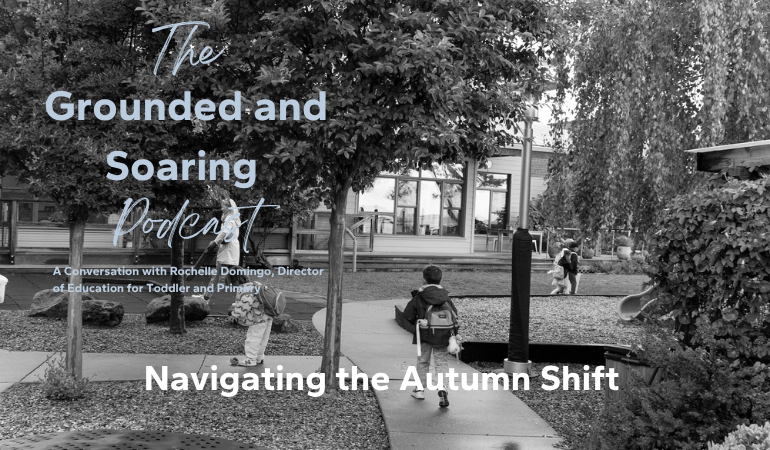
Back-to-school season doesn’t have to feel like a parenting stress test. Discover how Montessori routines, prepared environments, and unstructured downtime help navigate after-school meltdowns, reduce family anxiety, and build lasting confidence.
Episode Transcript
Navigating the Autumn Shift
00:04
Terry Dubow
All right, everybody. Welcome back to Grounded and Soaring, our podcast for parents trying to raise healthy kids in a too often unhealthy world. I’m Terry Dubow. I run the communications around here at Marin Montessori School. We hope everyone had a good, restful break. And I know for a lot of families, it can be kind of a stressful time. It can feel less like a fresh start and more like a stress test. The calendar will fill up. The morning alarms return, and people like me are filling your inbox with Parent Square messages. And so the pressure to manage it all smoothly can feel overwhelming.
00:31
Terry Dubow
And that’s why I’m thrilled to introduce our new Director of Education for Toddler and Primary, Rochelle Domingo. Rochelle brings a deep expertise in early childhood development. So Rochelle, thank you for joining and welcome to Grounded and Soaring and to Marin Montessori School. Thank you. Thank you so much, Terry. I am excited and really, really grateful to be part of the Marin Montessori School community. And I’m really excited to have this conversation because I think that this time of year brings up so much for families. Families are navigating so much as they start this school year with us. And we’ve got some great questions here that hopefully will flesh this out. We’ll also have a chance to talk about you a little bit, which is a very important part of this whole process. But first, let’s talk about kids and parents. Why has back to school season become such a cultural stress test for parents?
01:23
Terry Dubow
And what is this frantic energy actually doing to a family right as the school year starts? Yeah, I think that one of the things that makes this time of year so hard is that there is this expectation that somehow we have it all figured out immediately. Summer ends, school starts, and suddenly we’re supposed to have the morning routine figured out, the after school schedule figured out, lunches are packed, everyone is getting enough sleep, and somehow we are all getting out the door and we’re feeling really good about it. And transitions just don’t really work that way. Their transitions are difficult for us as adults, but they’re especially difficult for young children. For a two, three, or even five-year-old, starting a new school year is a really significant developmental transition. Even if they’re returning to the same school, there may be a new classroom, new adults, different children, or simply just a different rhythm than summer and their brains and their bodies are doing a tremendous amount of work adapting to all of that.
02:37
Rochelle Domingo
And I think adults are Doing that too. We’re adjusting our schedules, we’re separating from the children again, and sometimes we’re carrying our own worries about how they’re doing. If you’re able to start practicing some of these new routines ahead of time, great, that’s wonderful. But I also recognize that it’s just not always realistic. Sometimes summer comes to an abrupt end or you’re coming back from traveling. So I think a big part of this is giving ourselves and our children some grace. As we move through these transitions. And navigating transitions is actually a really important part of children’s developmental work. We often forget about that. And for some young children, this might be the first time that they’ve experienced a big transition like this. And they’re learning. They’re learning what do I do when things feel unfamiliar? How do I manage these big feelings? How do I begin to regulate my? These big feelings? Those are all skills that they’re developing and they’re all skills that are being actively supported within the Marin Montessori School community. So I would encourage families to not measure the first few weeks by how quickly everything feels smooth or perfect, right?
04:00
Rochelle Domingo
But to give yourselves permission to be in transition. You don’t have to have the entire school year figured out in that first week. Yeah. I was remembering a little bit. Figure it out in that first week. I was remembering a little bit about how our daughter, who’s now again 26, she cried every day. The first day of school, all the way, I think, through middle school. And she’s fine. But it didn’t feel that way at that moment. No, it was terrible. Poor kid. So, one of the things, back to crying, we often can see the strange phenomenon when school starts where a child could have a great day in the classroom or at school, but the second they get home or get in the car, they sort of melt down. What’s actually happening internally for a two or three or five year old during this transition?
04:47
Terry Dubow
Why can some of them hold it together during the day and then not so much when they get home? Yeah, I really love this question because this is something that so many families experience. A parent might hear when they come to pick up their child, they had a wonderful day, and then they think, Are you sure you’re talking about my child? Because then we get in the car and they completely unravel five minutes later. But when you think about what a young child is doing all day, it makes so much sense. They’re navigating a social environment. For some, this might be the first time that they’re doing that, especially on their own. They’re taking in language, they’re practicing new skills, they’re managing impulses, remembering expectations, making choices separating from parents, and their developing brains are working incredibly hard as they absorb everything around them, every sense around them, everything they hear and see and touch. And then they get to you at the end of their day, and you are their safe place. And sometimes what looks like a child completely unraveling is actually their release, after spending hours working really hard, working hard in the classroom, working hard to navigate and regulate themselves in a school environment.
06:13
Rochelle Domingo
And I think that is really why the Period after school is so important. We sometimes want to ask children as soon as we see them, “How was your day? What did you do? Who did you play with?” And they might just not have the capacity for that yet. Sometimes really, first what they need is food, water, movement, for some just closeness or just quiet. We can give them a little Are just quiet. And we can give them a little space to land before asking them to engage with us again. Yeah, I am reminded of my wife, who is very smart in these ways.
06:52
Terry Dubow
And she would say, like, you know, you actually, it’s a kind of a sign of success if you get their worst selves or their hardest selves because that’s where the trust is. Of course, that makes the act of parenting even more frustrating. I’d love to have the kid who’s so compliant and happy. That’d be great. So, speaking of that, in our toddler and our partner that’d be great. So, speaking of that, in our toddler and our primary classrooms, you can see 20 young kids moving with calm and independence and purpose, but at home, simple moments like getting out the door in the morning or all that can just feel like an Olympic event. So, are there Montessori principles of order and predictability that we use in our classrooms that maybe parents can maybe learn from in their own home? Yeah, absolutely. It’s funny, I was just talking to one of our primary guides this morning and this came up.
07:41
Rochelle Domingo
So the timing feels perfect. But I always smile at this because I think parents look into a Montessori classroom and they think, How are 20 children doing this when I can’t get my one child to put on their shoes in the morning? But the classroom has been intentionally designed to support the child and to support the child specifically in the stage of development that they’re in. And in Montessori terms, we Call this the preparation of the environment. So you’ll likely hear this term a lot this year if you haven’t already. And one of the things that Montessori understood so, so well is that children have a deep need for order and predictability, specifically, children from zero to six, really. They feel more secure when they know what’s going to happen and when their environment allows them to participate independently. In a Montessori classroom all of the materials have a place.
08:45
Rochelle Domingo
The routines are consistent, children know where their belongings go, what happens when they arrive, and what comes next. And this helps children build trust in both the adults and the environment. And then we practice these routines over and over. The environment really is a place where the world slows down for the child, they have time to repeat things to move at their own pace, and to begin to internalize these routines through their own experiences. And while our homes aren’t classrooms, we can borrow some of these same principles. For mornings, that might mean that your child has shoes and backpacks in the same accessible place every day.
09:36
Rochelle Domingo
Maybe it’s in a small basket in front of your door. Maybe their lunchbox lives there too. Maybe they help pack their lunch in the morning. Maybe breakfast has a predictable rhythm. Or there’s a simple sequence that they just begin to internalize. You get dressed, we eat breakfast, brush your teeth, put your shoes on, get your lunchbox, and then we go. And again, it’s that consistency every single day. But the prepared environment isn’t just about the physical space. As adults, we are also part of the prepared environment, right? Both at school and at home. So our predictability matters too.
10:19
Rochelle Domingo
Young children are incredibly attuned to us. They’re so, so intuitive. They’re reading our faces, our tone, our body language, our energy. And if we are communicating, even unintentionally, we’re late, we gotta go, it’s really stressful, they’re gonna feel that urgency too. But that doesn’t mean we have to be perfectly calm every morning, right? We are also human, so sometimes we are rushing at the door at 7 30 in the morning. But when we can be clear and consistent about what happens next, children don’t have to renegotiate that routine every day. And when our energy communicates, I know what comes next, I got you, we can do this, then that sense of confidence and that predictability helps them to feel secure. And I think another piece is just allowing more time whenever we can. Young children move at very different paces than adults. So while we’re thinking we need to leave in four minutes to get to school on time, and they’re thinking, whoa, I just found this really cool thing under the couch and I want to know how it works. So the more that we can set up the environment and the routine to do the reminding for us, the less time we have to spend in the morning directing or correcting or rushing.
11:44
Terry Dubow
Can you explain a little bit? Like, how would the environment remind them? Yeah, so setting up Spaces. So, when they are transitioning now, it’s those cues, right? So, in the beginning, after breakfast, it’s time to brush teeth. So, every day, it’s that same routine. We brush our teeth, then change shoes, we grab our things, and then we go. And so, sticking with that, it’s the same process every day, same thing. It might feel a little monotonous to us as adults, but children thrive when those routines are consistent, right? Thrive when those routines are consistent, and then you’ll start to see that you might not even have to remind them, because they’ve got it down. Yeah, and so those are the moments that we just take a step back and we observe and we watch it, watch them do it for themselves, or we see where they’re struggling and where they might need some more support. Right. Okay. So now, as the school year picks up, there’s going to be some some for some families some pressure and maybe it’s. Just logistical to sign up for afternoon activities, to get extracurricular. To sign up for afternoon activities, to get extracurriculars, you know, maybe somewhere someone starts a soccer program or something like that.
12:52
Terry Dubow
And that can sometimes be complicated because, you know, in Montessori, talk a lot about preserving a child’s natural work cycle and avoiding interruptions. And so creating all these other requirements might feel counter to that. Why is unstructured downtime so critical during these first few weeks of school at least? And how can parents sort of resist this fear that their kid isn’t? Doing enough stuff. Yeah. You know, I think that sometimes. We really underestimate how much work a school day really is for a child, right? It’s fun and they’re playing with their friends and they’re so engaged, but it also is a lot of work.
13:31
Rochelle Domingo
And in Montessori, we talk about the work cycle, like you just said, and really in that work cycle, what we’re doing is we are protecting these sustained periods where children can choose work, they can concentrate, they can repeat something, move, observe, and really follow their own interests without constantly being interrupted or redirected. This interrupted space really gives them an opportunity to dive deep into what psychologists call flow, that feeling of doing your best work, and it really feels effortless. And after spending a full day doing all of that developmental work, children need recovery time too.
14:14
Rochelle Domingo
And just like us adults, children are going to unwind and they’re going to regulate themselves in different ways. So for us, right some of us like to go to the gym. We find that to be a healthy outlet. Some of us like to go for a walk or just spend time cooking a really nice dinner with the person that we love. And young children are really still discovering what that is for them. What does their wind down look like? What grounds them? What are they drawn to? What helps them settle? This is all part of their work.
14:51
Rochelle Domingo
And so part of supporting that development is actually giving them enough time and space to discover these things for themselves. And while they’re doing that, we can take a step back and we can observe and we can pay attention to what it is that they’re showing us that they need. And this unstructured time is so important because it gives them time process. It gives them time and opportunity Them time to process. It gives them time and opportunities to be bored. There’s a lot of conversations happening about the importance of boredom in children right now, and it is quite important to have that unstructured time, to maybe invent something, to move their bodies, to play, or just do nothing for a little while. And boredom really isn’t, it’s not something that we need to fix. Some really, really wonderful Creativity can come from a child having enough space to just wonder, “what am I gonna do?”
15:49
Rochelle Domingo
But at the same time, I also understand the pressure that parents feel because there really are so many wonderful opportunities out there. There’s sports and music classes, and they can absolutely enrich a child’s life. So it’s not that the structured activities are bad, it’s just balance. Especially at the beginning of the school year. I would encourage you to protect some of that white space. Right? See how your child is doing before filling every afternoon and weekend, and remembering that your child isn’t falling behind just because they have some time to play. Yeah, yeah, it’s really important.
16:29
Terry Dubow
Yeah, it’s a lot, and it’s a long road, it’s a long. It’s really important. Yeah, it’s a long road. And for us as adults too, right? Having some unstructured time. So you can just have time to spend with your kids, you know, and to watch them. That’s part of the loss of summer is you can sort of feel like that was so limited and now it’s gone. It doesn’t have to be. Right. All right, we’re gonna talk about kids a lot over the next year and years. Let’s talk about you for a second. How’s it feel? Like you’re jumping into this new school and this new role. And just yeah, how’s it going? Yeah, I am feeling really excited. And honestly, I’m still taking so much in. One of the things that I’ve really appreciated most in my first few weeks is just getting so many opportunities to get to know the incredible people who make up this community. I’ve spent a lot of time listening, talking with guides, meeting families, and learning the culture of Marin. And I’ve spent most of my career working with young children and families and educators, and I find those connections to be so meaningful and so inspiring.
17:40
Rochelle Domingo
But every school community has its own little ecosystem, so it’s important to me to really, really understand this one and to really understand the relationships with all of the people who make this community what it is. But I’m especially excited about the partnership piece of this role. These early childhood years are incredible. They’re full of curiosity and magic and wonder, but for parents, it can also feel challenging or confusing, and if we’re honest, sometimes a little overwhelming. So I love being able to work alongside families and work alongside our guides, our really experienced, incredible guides here during this really important stage, the stage that we all really.
18:26
Rochelle Domingo
Enjoy. So they really say it takes a village. And I’m already seeing how much Marin Montessori really is that village. Families, there’s just so much care and commitment here from the families to the guides, and so I’m excited, I’m curious, and I’m really grateful. We’re really glad you’re here. So, in your role, you’re gonna walk alongside dozens of families navigating these early years. If you could give parents just one core truth, one good piece of advice to hold on to. During these first hectic weeks of September, August, September, what would it be? Yeah. If I had to choose one core truth, and I would honestly say this is applicable to just this period of development in general, but especially in those first few weeks, I would say that our job isn’t to remove every discomfort from our children’s experience, and that can be really hard as adults, right? But it’s to create this loving, supportive environment that helps them move through it and to begin to trust that they can do this. And it’s so natural as parents to want to remove discomfort. You want the goodbyes to be tear free, you want the morning to go smoothly, you want your children to come home happy every day, and you probably want them to tell you all about their day in every detail, right?
19:51
Rochelle Domingo
But really honoring that discomfort is a part of growth. And I like to sometimes think about it as waves. Our job isn’t to make every single wave disappear for the children, but it’s to be the steady, calm anchor while they learn that they can navigate the waves for themselves. And again, children borrow so much from us. So when we can communicate through our actions and our words that I know this is hard and I know you can do this, we’re giving them something that’s so much more powerful than a perfectly smooth transition. We’re helping them build confidence in themselves, and little by little, we’re helping them really build the ability to navigate hard things on their own while also knowing that they have this safe and nurturing place to land.
20:42
Rochelle Domingo
And those are the skills that they are going to take with them for the rest of their life. So I would say if September feels a little messy, that’s okay. Give your child time, give yourself time, and remember that you’re building this rhythm together and you have an entire community at Marin Montessori to support you while you do that. Well, perfect. Thank you so much for joining us both on the podcast and at the school. It’s really wonderful. I think families are going to have a great experience with you as the leader of the toddler and the primary program.
21:18
Terry Dubow
Thanks for joining the launch of season five. We’re excited about that too. We’re fortunate to have you here. And to our listeners, thanks for tuning in. If you want to explore more articles Insights, podcasts, all of that, you can just go to groundedandsoaring.org and follow us on your socials, all the rest. So, anyway, thanks, Rochelle, for joining. Thank you. All right. Thanks so much.

Terry is the Director of Communications and Strategic Initiatives at Marin Montessori School. A classroom teacher for 30 years, he manages Grounded and Soaring.