
I recently returned from a summer leadership program with 25 other heads of school from around the country. We spent five days together rafting the Salmon River in Idaho, with each day bookended by a leadership development seminar focused on purpose-centered leadership. At the conclusion, we spoke of what was most revelatory and transformative about the experience. For several, it wasn’t actually about navigating class-four rapids or even the seminar content. It was the quality of their presence that blossomed after five days without their smartphones. They loved it.
But are we really surprised? In a recent study, parents received an average of nearly 300 mobile notifications each day and picked up their phones 93 times. These notifications provoke greater daily stress and distraction, which, in turn, lowers the quality of parent-child interaction and communication.
In 1934, T.S. Eliot wrote, “Where is the life we have lost in the living?” Today, the question is poignant, for each of us is navigating the new reality of “technoference,” which can be understood as the everyday disruptive intrusion of digital technology into our present-moment experiences, including our face-to-face interactions, relationships, and solitude.
Technoference is an under-discussed risk to our parenting: It degrades our well-being and capacities to parent our children as we aspire, yet it’s so normalized and even expected in some work and social cultures. Writer Annie Dillard reminds us, though, that “How we spend our days is, of course, how we spend our lives,” and for our benefit and our children’s, it’s essential that we grapple with technoference’s impact on our days and lives. As former U.S. Surgeon General Vivek Murthy notes in his advisory, “Parents Under Pressure,” “…supporting children increasingly requires supporting the mental health and well-being of parents themselves.”
The Reality of the Challenges We Face
Navigating technoference and remaining present and intentional in our lives is not easy. When I heard Yuval Noah Harari speak about his newest book, Nexus: A Brief History of Information Networks from the Stone Age to AI, I was struck by his warning that human beings are simply not built to adapt effectively to the unprecedented speed of today’s technological changes. As warm-blooded, living, breathing, organic mammals, we are designed to live by rhythms of activity and rest, attention and recovery. Yet digital technologies, algorithms, notifications, and the relentless stream of news headlines operate according to an entirely different pace and rate of change: they are always on, always updating, and always competing for our attention.
Our capacity for attention is limited, and these repeated interruptions make sustained focus, psychological recovery, and genuine presence with our moment-to-moment experience and relationships increasingly fraught. There may never have been a time in human history when being genuinely present with our lives and the people we love has been more profoundly challenged.
Reasons for Hope: Our Agency and Our School
I regularly hear from parents that it is in their parenting where they most desire a stronger capacity for presence. Specifically, they express an ache about how quickly their children seem to be growing up, as well as a longing to capture and hold forever their children’s particularly treasured qualities. In these conversations, I’m always reminded of the sweet ache illuminated in this brief, favorite Adrian Mitchell poem:
Beattie is Three
At the top of the stairs
I ask for her hand. O.K.
She gives it to me.
How her fist fits my palm,
A bunch of consolation.
We take our time
Down the steep carpetway
As I wish silently
That the stairs were endless.
There is good news: We can actively cultivate presence. We can address technoference, wrestling to manage it more than it manages us. We can develop daily practices that support our mindfulness (simply defined as being fully present and aware of what we are doing, thinking, feeling, and sensing in the moment). The research reveals that increasing our present-moment attention increases our life satisfaction and moment-to-moment happiness.
Though the pressures of today’s world make it difficult (and for some of us, our career success is seemingly inextricably bound with unprecedented new levels of “always on”), as we parent, we have the power to access this greater well-being. Through our own discipline, and through setting up structures and systems (the inspirational Center for Humane Technology even suggests tech out there to help us), we can grow stronger attention, allowing us to be more closely connected with our children as they shimmer in their changing; we can more fully savor and take in the magic of who they are now, and then now again. We can experience our children as Mary Oliver describes in her poem, “Snow Geese”: “…What matters/is that, when I saw them,/I saw them/as through the veil, secretly, joyfully, clearly.”
These salutary effects will also expand to our lives beyond our parenting. We become fully engaged and enriched by our lives, avoiding the tragedy T.S. Eliot cautioned against: “We had the experience but missed the meaning.”
There’s also good news for our MMS children. As we adults work to manage technoference in our lives, the MMS kids are all right: MMS remains a refuge from the storms of degrading distractions. It’s not surprising, then, to read the study published in the American Journal of Education, which found that Montessori students engage in deeper and longer states of concentration (“flow”), compared to any other teaching approach. (It’s noteworthy that the study’s co-author, Dr. Mihaly Csikszentmihalyi, who wrote the legendary book, Flow: The Psychology of Optimal Experience, was an MMS grandparent.) Quality concentration matters: Research also suggests that Montessori students make greater gains in academic learning and experience greater enjoyment of academic tasks.
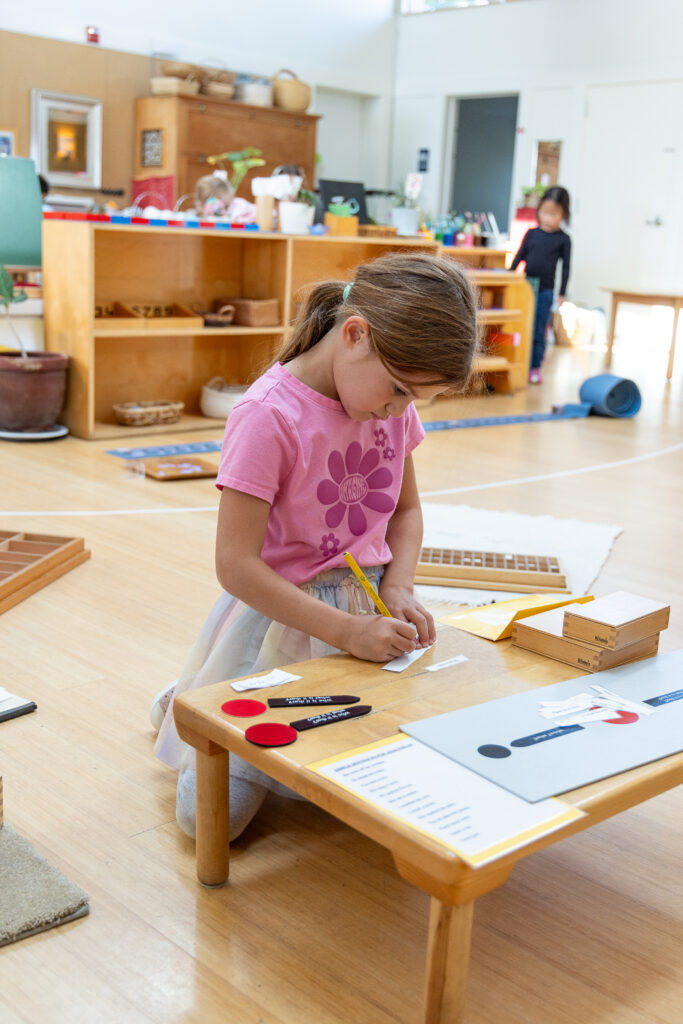
A few highlights of how we at MMS cultivate and sustain your children’s presence in their daily experience include:
- The three-hour work periods in Primary and Elementary, which are intentionally uninterrupted by bells or the disruptive practice of sudden required switching from subject area to subject area;
- The three moments each day at the Junior High when the community pauses for minutes of mindfulness practice (new research suggests that children and adolescents benefit greatly from regular, daily time for mindful quiet);
- The nature-rich experiences of all of our students each day (our children’s mental health and overall well-being benefit from engagement with nature);
- The emphasis throughout our school on human-centered experiences while avoiding or minimizing screen use. (Here, cognitive neuroscientist and educator Dr. Jared Cooney Horvath’s testimony before a Senate committee is compelling. In it, he explains that across international data, educational performance tends to decline after countries introduce digital technology broadly into schools.)
Our Larger Aspiration: Be Your Own Beacon
We are raising our children in a world that continuously bombards them with content. They are shouted at through attention-captivating screens to care about what other people are doing, wearing, and valuing far more than about their own rich, in-real-life, moment-by-moment experiences, perspectives, and needs.
If our children get captured by the messages of what everyone else online tells them who they should be and what they should value, they risk just being actors, living outside-in. Meaning, they risk focusing their lives on performing back to others a caricature of who they think those other influencers want them to be. As the scholar Joseph Campbell cautioned, “If you don’t find your own path, you’re going to be serving someone else’s.”
When our children live, instead, more from the inside out, when who they express themselves to be in the world is a genuine reflection of who they really are inside, they flourish. They discover another Joseph Campbell revelation, that “The privilege of a lifetime is being who you are.”
For all of us to access that privilege, we’ll need to prevent the cacophony of technoference content from shouting away the most valuable of voices: The voice that lives within each of us. It’s only when we get quiet, really quiet, that we can then listen and hear what we know inside to be true—when we can hear what truly matters most to us.
In a recent message, Pope Leo eloquently summarized this time in which we are raising children, along with a vision for their flourishing:
Connecting young people to digital networks serves no purpose if they remain disconnected from themselves, others, and their own interiority. We must help young people rediscover silence, reflection, the ability to ask questions, the depth of relationships, and openness to transcendence. To listen to the soul, we must lend an ear, because the soul’s voice is not a shout, but a whisper.
As parents and educators, here is our charge: First, to assert our agency in managing the deleterious impact of technoference. And second, to model this for our children so that they continue to navigate their lives by the North Star of their inner knowing rather than screen-based phantoms shouting for their attention; let’s empower our children and students to anchor themselves in the core of who they are and to live this self-awareness out loud.
Expressing their lives with genuineness won’t always be easy or clear for our children; in fact, finding their balance between their desire to fit in with their peers and sustaining their authenticity can sometimes be difficult and opaque. But for their singular, “…one wild and precious” lives, let’s inspire our children not to waste these on other people’s noise. Let this be both our own practice that we grow through our presence, and the message we gift to our children:
Be your own beacon. Be your own bell. Ring. Shine. Sing. Dance.[/vc_column_text][/vc_column][/vc_row]
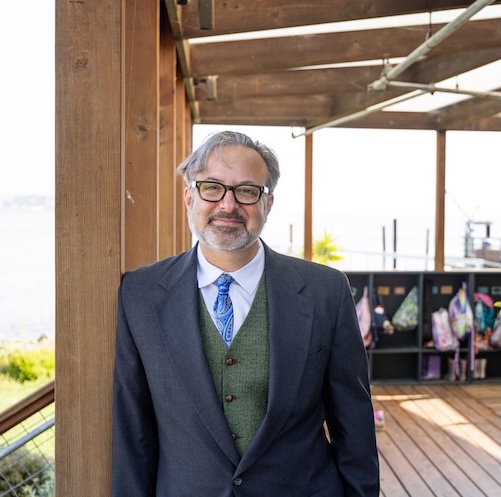
As Head of School, Sam is responsible for ensuring that Marin Montessori flourishes and that the School’s mission is brought to life each and every day.