
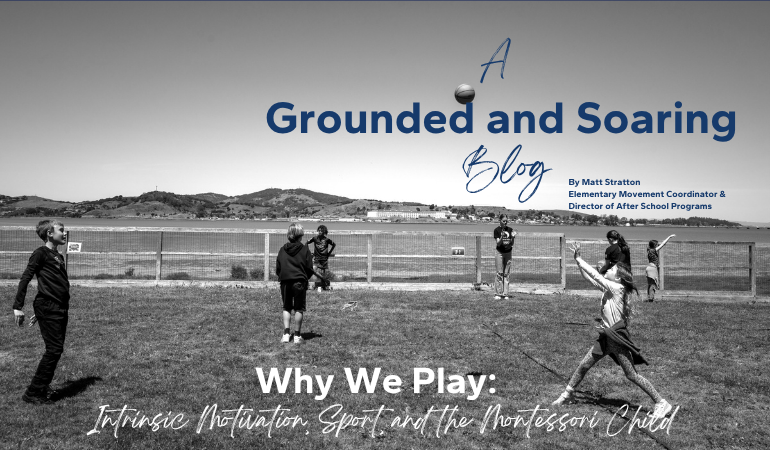
At some point, if you watch enough children play, you see it happen. A child who has been struggling with throwing, dropping catches, and getting frustrated suddenly goes quiet. Not a defeated quiet. An absorbed quiet. The trying stops, and something else takes over, a state where the challenge and the child are the same thing, and nobody needs to tell them to keep going: they want to compete. That state is not accidental. It cannot be demanded or scheduled. But it can be cultivated, and when it is, the results are extraordinary.
Norway built a national sports policy around it. Steph Curry embodies it. And it is, I believe, the most powerful force in athletic development that most youth sports programs never think about.
Movement Is Not a Break from Learning. It Is Learning.
In many educational approaches, physical activity is often treated as a release valve, something children need so they can return to the “real” work of sitting still and absorbing information. Dr. Montessori understood this to be a false division. As she wrote, “Movement, or physical activity, is thus an essential factor in intellectual growth, which depends upon the impressions received from outside. Through movement we come in contact with external reality, and it is through these contacts that we eventually acquire even abstract ideas.”
This is not a metaphor. It is developmental science, articulated more than a century ago. When a child learns to dribble a basketball, they are not simply training their hands. They are building spatial reasoning, rhythmic timing, anticipatory thinking, and the capacity to hold a mental model of another person’s position on a court. When a child learns to read the flight of a soccer ball, they are doing physics. When they learn to play within the rules of a game without a referee watching, they are practicing ethics.
The body and the mind are not separate instruments. In the Montessori view, they are one, and the movement program is where that unity becomes most visible.
Intrinsic Motivation: The Engine Underneath Excellence
There are two kinds of athletes. The first practices because someone is watching (a coach, a parent, a scoreboard). The second practices because they are compelled from within, because the gap between where they are and where they could be is genuinely fascinating to them; getting better and competing is its own deep satisfaction. Both approaches can produce impressive results in the short term. Only one produces a great athlete over a lifetime.
This intrinsic motivation is the true engine underneath athletic excellence. It is not opposed to ambition. It is ambition, properly rooted. A child who is intrinsically motivated to expand their limits through love of movement will outwork, out-persist, and outlast the child who is performing for external validation. Every time. And, over the long arc of their lives.
Our Montessori movement program is built around cultivating exactly this quality. Athletic awareness and skill are pathways, the means through which children discover what they are capable of. The goal is a child who is internally driven to push further, who finds joy in challenge, who brings their full self to competition not because they fear losing, but because bringing their best is genuinely thrilling.
That kind of athlete can become elite. And they tend to.
The Norway Question
Consider Norway. A country of 5.6 million people (roughly the population of Colorado) that set a Winter Olympic record at the 2026 Milano-Cortina Games, winning 41 total medals and 18 golds, the highest gold count by any nation in Winter Olympic history. Their per-capita medal output was so extraordinary that analysts calculated the following: if the United States performed at the same efficiency, it would have won over 2,500 medals, more than seven times the total number available.
Norway has dominated the Winter Olympics for decades. The question worth asking is: How?
Part of the answer is geography and culture. But another significant part is a formal national policy on youth sport that is, by American standards, startling in its restraint. The Norwegian Olympic and Paralympic Committee and Confederation of Sports has a codified set of children’s rights in sport that, among other things, prohibits competitive scorekeeping in organized sport until age 13. The explicit philosophy (their national term for it is idrettsglede, the joy of sport) is that the goal of youth athletics is not to identify winners early. It is to develop children who love to move, who are internally driven to improve, and who stay in sport for life.
The results speak for themselves. In Norway, 93% of children participate in youth sports. In the United States, the number is closer to half; the number one reason U.S. children drop out is that they stop having fun.
Norway is not producing soft athletes. Their competitors are, by any measure, among the toughest and most technically accomplished in the world. What Norway understood is that joy and excellence are not in tension with one another. Joy, properly cultivated, produces excellence. Remove the joy early by focusing on results, and you lose the athlete. Keep the joy central, and you build someone who will push their limits for the rest of their life.
Steph Curry and the Compulsion to Improve
Steph Curry (four-time NBA champion, widely considered the greatest shooter in the history of professional basketball) attended the Christian Montessori School of Lake Norman through sixth grade, a school founded and directed by his mother, Sonya Curry. In a video produced by the American Montessori Society, he said simply: “Montessori has helped me become the person that I am today.”
What he describes, when pressed on what that means, is not a set of skills or subjects. It is an orientation. Montessori gave him the capacity to learn at his own pace, and to identify his strengths and work honestly on his weaknesses. Most importantly, through Montessori, he established asettled internal belief that he could achieve anything he set his mind to. He also credits his Montessori education with teaching him how to work through the thorniest of challenges without becoming discouraged by barriers and breakdowns.
That last part deserves to sit with us for a moment. The ability to hit a wall and not be discouraged, to treat an obstacle as information rather than verdict, is not a minor psychological trait. In sport, it is almost everything. Talent is common. The capacity to keep going when progress stalls, when a skill won’t come, when the gap between where you are and where you want to be feels humiliating, that is a rare capacity. And it is precisely what a Montessori environment builds, quietly and consistently, through years of self-directed work.
Watch any account of how Curry actually trains, and what is striking is not discipline in the punishing, external sense. What is striking is the fascination it evokes: His legendary warm-ups (i.e., the behind-the-back catches, the off-balance releases, the increasingly improbable shots he invents simply to find the edges of what’s possible) read less like obligation and more like a person deeply absorbed in a question only they are asking. The question is: How good can I get?
That question, once it takes root in a child, is essentially self-sustaining. Nobody has to push Steph Curry to practice. The pull is internal. And it did not begin in the NBA. It began in a Montessori classroom, where a child was trusted to direct his own learning and discovered that growth, in itself, is its own reward.
Spirit of the Game
There is one more piece of this puzzle of internal drive toward improvement. In the sport of ultimate frisbee, there is a concept called Spirit of the Game: the idea that players are responsible not only for their own conduct, but for the quality of the experience they create for everyone on the field, including their opponents. No referee. No external authority. Just players who have internalized the value of fair, honest, joyful competition.
The highest expression of this is an opponent who brings everything they have to the game. Not someone who holds back, not someone who plays small so you feel comfortable, but someone who safely competes at their absolute limit, because that is what makes the game worth playing. You want to beat someone playing their best. You want to be beaten by someone playing their best. That mutual striving is the point.
Dr. Montessori understood something similar about the child’s will: “Since it is through movement that the will realises itself, we should assist a child in his attempts to put his will into act.” Grace and courtesy on the field (e.g., congratulating an opponent, helping someone up, competing hard, and shaking hands after, etc.) are not decorative behaviors. They are expressions of a will that has been cultivated to be both strong and generous. That combination is rare. It is also the mark of every great athlete you have ever admired.
What This Looks Like at Marin Montessori
Our movement program is built on the conviction that the most direct path to athletic excellence is a child who loves to move and loves to be challenged. When the children in our Upper Elementary program were recently asked to articulate their own philosophy of sport, one of them put it simply: “We compete to see how far we can go.”
That is the whole philosophy, in nine words. Not a ceiling on ambition, but a direction for it. A child who competes to find their own limit will push harder, recover faster, and stay in the game longer than one who competes only to beat the person next to them or chase accolades. They will also, not coincidentally, be the teammate and opponent everyone wants to share a field with. Joy and excellence are not in tension. In our experience, in Norway’s data, and in the story of a kid from a Montessori school in North Carolina who became the greatest shooter in NBA history, they are the same thing.
A note on sources: The Maria Montessori quotes in this piece are drawn from The Absorbent Mind (1949), and The Secret of Childhood (1936), and verified through American Montessori Society published materials. The Steph Curry quote is drawn from the American Montessori Society’s video Living Montessori: The Curry Family, available on YouTube. Norway’s participation and policy data are drawn from the Norwegian Olympic and Paralympic Committee and Confederation of Sports’ official Children’s Rights in Sport documentation. The student quotes are used with the permission of the Upper Elementary class. The 2026 Winter Olympics data reflect the final medal count from Milano-Cortina 2026.

An Anchorage native and lifelong Montessorian, Matt attended both Primary and Elementary programs before moving south for the redwoods and sunshine. He holds a degree in International Studies from Sonoma State, an AMI diploma from Montessori Northwest, and a Master’s in Montessori Education from Whitworth University. An avid athlete and cook, Matt spends his free time playing competitive ultimate frisbee and exploring the outdoors. He serves as the Elementary Movement and Director of Additional School Programs at Marin Montessori.