

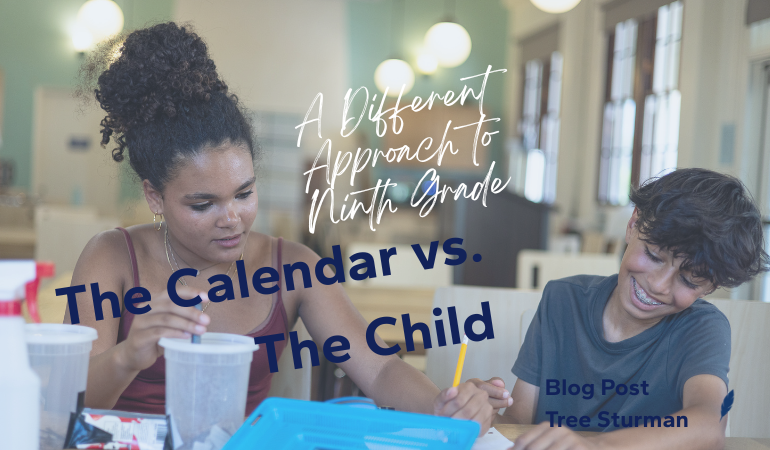
History has a funny way of deciding when a child suddenly becomes an adult. In the 1700s, you were essentially a “mini-adult” by age seven; by the mid-1800s, teenagers were raising families and captaining schooners; and yet, just a few decades ago, the US government briefly decided that 18-year-olds were mature enough to handle high-speed traffic and a beer, only to realize, quite tragically and quickly, that the human brain didn’t care what the law said.
We can side-eye the idea of a seven-year-old in a three-piece suit or a 19th-century teen lost at sea, but in our day and age, we tend to treat the 14th birthday as an equally sacred, non-negotiable starting line for the high-octane world of “Big High School.” We’ve been conditioned to believe that readiness is a light switch that flips the moment the calendar hits 9th grade. But what if that “starting line” has more to do with 1990s geopolitics than with the actual, jagged reality of the adolescent experience?
Rethinking Readiness
The value and importance of the Full Cycle (9th-year) at Marin Montessori cannot be overstated. It is the year when everything we know about education, and everything we understand about adolescent development, synergizes and crystallizes into something genuinely powerful in the lives of our students. The proof of this can be found in every young person who completes what is intentionally designed as a three-year Marin Montessori Junior High program.
And yet, choosing to stay for the Full Cycle year is rarely simple. I’m a parent myself, and I know how personal these decisions are. There are so many variables to weigh, and it’s easy to worry about getting it wrong. As an educator who has spent years studying this question and talking with families, I’ve concluded that many of the factors that may feel urgent in the moment have little to do with the one question that truly matters: What do I believe is best for my child’s future?
“The 9th-year experience is amazing. It is a year full of adventure that leaves you with immense confidence and satisfaction as you move on to high school.”
— MMS JH Full Cycle Graduate
Whether that choice is before you now or will be in the years to come, I offer this perspective in the hopes of making your decision a little easier.
Maturity Doesn’t Arrive on a Birthday
Recently, while discussing the Full Cycle year, a colleague of mine used the phrase “rite of passage” to describe the transition to high school. I found that framing compelling and decided to explore other rites of passage that happen during adolescence. As the parent of a college student, voting and drinking alcohol came immediately to mind.
So I did some digging.
It turns out that the legal ages for these milestones have shifted significantly, even within my own parents’ lifetime. These changes were driven largely by political forces rather than by any new understanding of adolescent readiness. For example, in 1971, when the legal drinking age was briefly lowered from 21 to 18, teen traffic fatalities skyrocketed. Although these young people were legally adults, many were not prepared for that level of responsibility.
Modern neuroscience now helps explain why. Adolescence extends well into our twenties, and the developing adolescent brain is uniquely wired for risk-taking, emotional impulsivity, and heightened sensitivity to peers. The science affirms what educators and parents have long observed, which is that maturity doesn’t arrive on a birthday.
The Quandary of Ninth Grade
Much like the drinking age, the transition to high school has become a cultural rite of passage. Yet many parents of my generation may remember a time when ninth grade was still part of “Junior High,” and “Senior High School” began in tenth grade. The now-common sixth through eighth grade “Middle School” model only took root in the mid to late 1990s.
History shows that these shifts were motivated by globalization rather than child development. Policymakers believed that by adding an extra year of high school, American students would be better prepared for the emerging global economy. Massive suburban high schools were built, and the nine through twelve model became the norm. The assumption did not pan out, but the buildings remained, and so did the structure.
From a developmental perspective, it was never the right move.
Too Much, Too Soon
Those of us who work closely with adolescents know that a typical ninth grader is experiencing dramatic physical and emotional growth. The combination of physical maturity and incomplete neurological development can create significant challenges, especially if a child looks more mature on the outside than they are on the inside. And yet we know that high school’s appeal, with its large peer communities, greater freedom, and broader social opportunities, can be intoxicating to a developing adolescent.
To successfully navigate high school, a young person needs a wide range of social, emotional, and academic skills, yet the standard 6–8 middle school model gives them only a painfully short window to develop them. When you layer the complex social world of early adolescence with the academic rigor and extracurricular expectations of high school, our children face very real and lasting consequences of too much, too soon: anxiety, depression, overwhelm, and a profound loss of self.
Add to this the dizzying pressures of social media, generative AI, and the increasingly competitive landscape of selective high schools and colleges, and it becomes clear how today’s adolescent mental health crisis has taken root.¹ ² ³ The good news is that we as parents still have tremendous agency. It begins and ends with the same guiding question as before: “What do I believe is best for my child’s future?”
If your child is currently at MMS Jr. High, you have already chosen a school where your child is valued as an individual. This is a place where they are safe, known, and supported as they explore who they are, what matters to them, and what they want to contribute to the world.
As you reflect on this important decision, I encourage you to set aside any assumption that high school must begin after eighth grade or that biological age determines true readiness. As a parent of a college sophomore, I’m still learning when to empower and when to step in. It isn’t easy, and it hasn’t always gone according to plan. But along the way, I’ve learned the immeasurable value of the gift of time. Children only get to be children for so long, and once high school begins, there is no turning back.
At MMS, we know that students who stay for our Full Cycle year leave with a highly durable sense of self, authentic resilience born out of productive struggle, and the ability to navigate the world on their own terms. They enter high school not simply out of desire or because the calendar says it is time, but because they have demonstrated to us and to themselves that they are genuinely ready.
-
- CDC Youth Risk Behavior Survey Data Summary & Trends Report (2023)
- U.S. Surgeon General’s Advisory: Protecting Youth Mental Health (2021)
- AAP-AACAP-CHA Declaration of a National Emergency in Child and Adolescent Mental Health (2021)
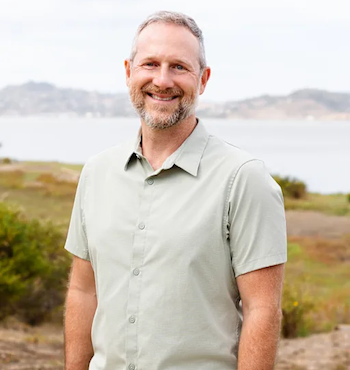
As the Director of the Junior High, Tree draws on a diverse background in human ecology and environmental leadership to help students navigate the “jagged reality” of adolescence. A co-founder of a successful Montessori junior high program with over a decade of experience, he is a lifelong learner who pairs deep pedagogical expertise with a parent’s empathy. Whether tinkering with vintage typewriters or exploring the Marin hills, Tree is dedicated to ensuring students leave MMS with the durable sense of self required to soar.


Jeannette Schar
Thank you, Tree. What a wonderful perspective and an opportunity for us to truly ponder the meaning and intent of a full childhood. Dr. Montessori understood childhood not as a linear time but a circuitous path of curiosity. The MMS Full-Cycle year is the realization and embodiment of the launching pad for confident young adolescents.